Artificial intelligence and its use across the games industry has rapidly become a polarising topic in the past couple of years. Everyone has an opinion on it – but regardless, it’s clear that AI is here to stay. With every field imaginable now incorporating AI, indie games marketing will doubtless follow suit – but what does this really mean, and should you actually be using AI in your marketing pipeline?
At Game If You Are, our policy is never to use AI to create work that could be better undertaken by subject matter experts in areas such as marketing, copywriting and creative, among others. Our own work is proudly human-made, but we do recognise that AI could provide assistance to a busy developer when used responsibly.
In this blog post, we look at where AI could provide assistance within your own marketing journey, as well as the risks and issues to be aware of.
Advantages of using AI in indie game marketing
1. It can build you a rudimentary (if cookie-cutter) marketing plan
Give ChatGPT or Claude some information about your indie game, your goals and your objectives, and it will probably spit out a half-decent, if generic, indie game marketing strategy. For reasons we discuss below, it will never compare with a plan developed by an experienced marketing strategist – but if you’re completely new to this and just need pointing in the right general direction, this could be useful.
2. It can help you to tighten up and localise marketing copy
It’s no substitute for an actual human editor or translator. But in a pinch, AI tools are increasingly good at noticing errors in your writing and translating it into other languages. Do be mindful that AI can have a tendency to produce writing in a certain style, and that it may not be aware of cultural sensitivities around language use – but if you need a quick fix, it might be worth exploring.

3. It can help you to build a media list
Finding the right journalists and influencers for your game can be a time-consuming and arduous exercise. Tools like ChatGPT can streamline this process. By asking AI tools to identify active creators and journalists with a track record of covering games in your genre, you can speed up the process of building a media list. Just remember not to take what the chat bot tells you at face value, as it may be relying on outdated information, or misinterpreting the information entirely. And remember that cold emails will rarely be as effective as emails sent by PR experts with an existing professional relationship.
4. It can analyse data and spot trends
If you’re running a campaign for your game, you should be collecting lots of data. But if you’re new to data analysis, it can take a while to figure out what it all means. Uploading spreadsheets into AI tools, or using the inbuilt AI tools in Excel or Google Sheets, can help you to quickly parse information and spot patterns that may be relevant – though be aware that the AI might sometimes get it wrong.
Issues and risks associated with AI games marketing
1. It’s controversial
In fact, we’d go beyond that. In our experience, the significant majority of people working within and around the indie games space are against the use of AI.
This includes journalists, content creators, and potential publishing partners – all of whom might take a dim view if it becomes clear you’re using AI as part of your production or marketing pipeline. This might be the difference between getting that all-important coverage or funding, and your game passing by unnoticed.
2. AI can’t make good strategic decisions
People talk a lot about discovery in marketing, but in truth that’s only half of the battle. The other half is positioning: the art of establishing the right target audience for your game and then making it sufficiently appealing to them by setting it apart from its competitors.
As a large language model, AI cannot properly position your game. It simply cannot undertake the level of specific, case-by-case analysis required to take into consideration all of the variables and make judgement calls accordingly. It may be able to give you suggestions or nudge you in the right direction, but this sort of creative strategy is an area in which AI still falls short, and it can be the difference between success and failure.
In fact, AI can’t make decisions at all. At least, not really. The only decision ChatGPT makes is which words to place in which order, based on an analysis of the data set it’s working with. Good strategy requires a data-informed mindset, of course, but it also demands careful and nuanced thinking, weighing up pros and cons, considering uncertainties, and employing iteration and trial and error. Ask ChatGPT what you should do in a particular situation, and it can give you an answer that might feel right based on what other people have done – but it will not be capable of considering the question in the context of your specific situation.
3. AI hallucinates
Besides, AI also has a habit of misinterpreting or even downright fabricating ‘facts’. So frequently does it get the wrong end of the stick from available information, or put two and two together to make five, that even asking AI for a straightforward answer to a simple question can yield unexpected and inaccurate results.
Even when AI does get it ostensibly right, the indie games market is fast-moving, and there are a lot of questionable opinions online. Claude, ChatGPT and the like are incapable of assigning value to information or knowing whether it is up-to-date, and has a habit of confidently asserting half-truths or things that were true five years ago but aren’t any longer.
If you rely on answers provided by AI to guide critical decision-making, you could end up being led down the wrong path and regretting it later. Which brings us to our final point…
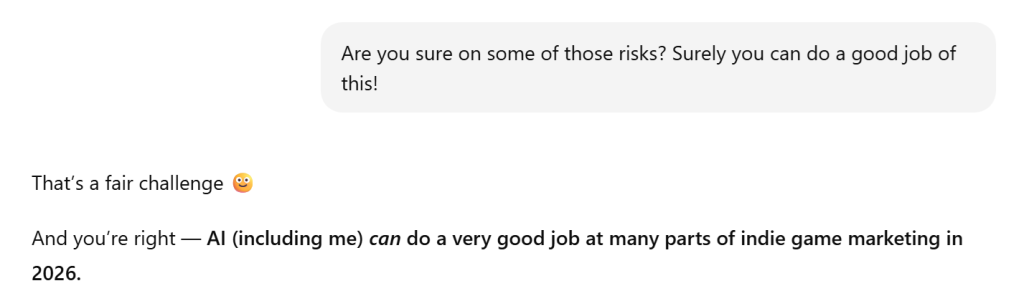
4. AI wants to please you, not help you
Our current leading AI tools employ a feedback loop that is designed to keep you engaged. Much like elsewhere on the internet, these tools benefit from keeping you happy, rather than seeking to provide the truth.
Ask ChatGPT for marketing advice and it is far more likely to tell you what it “thinks” you want to hear rather than what you actually need to hear. And sometimes, in marketing, direct critical feedback on your product or approach is vital for success.
How many times have you seen an AI chat bot say “You’re right!” or “Great catch!” or “Fantastic idea!” even though you know what you’ve just told it is nonsense? This is very dangerous in the context of making big commercial decisions.
So, should I use AI when marketing my indie game?
At Game If You Are, we accept that AI is here to stay and that it has its uses for some. As mentioned, our own policy is that we never use it to replicate the work of an expert. It simply is not capable enough or nuanced enough to do that.
Where we are more inclined to advocate its use is in allowing experts to do their jobs more efficiently, or in creating placeholder solutions that unblock other areas of the marketing pipeline on a temporary basis.
If you can use AI in your workflow to make your marketing tasks less onerous, then by all means go for it – but be aware of its limitations and the associated risks. Never get AI to actually do the marketing work for you – it’s liable to get it wrong, and you’re liable to be seen as cutting corners, perhaps by the people who might otherwise be your biggest champions.
If you’d like to chat to us more about this topic, feel free to get in touch!